
Book Review: ‘The Freedom Model for Addictions’
Book Review: ‘The Freedom Model for Addictions’ — A Look at a Radical Reframe
Addiction is an issue that seems to be only increasing more and more. Whether it be alcohol, drugs, gambling, pornography, or even our smart phones, more and more people are recognising compulsive behaviours that they feel they’re losing control over. With that, many people are looking for an answer to this problem, and while I have always subscribed to the belief that no one approach will work for everyone, ‘The Freedom Model for Addictions’ certainly offers food for thought.
’The Freedom Model’ can be a confronting read
There are books you read because you’re looking for answers, and then there are books you read because you want to challenge the answers you’ve already been given. The Freedom Model for Addictions falls squarely into the second category. It is not gentle nor does it politely ask to join the conversation on addiction. Instead, it pulls up a chair, kicks the legs out from under the existing table, and invites you to rebuild the whole thing from scratch.
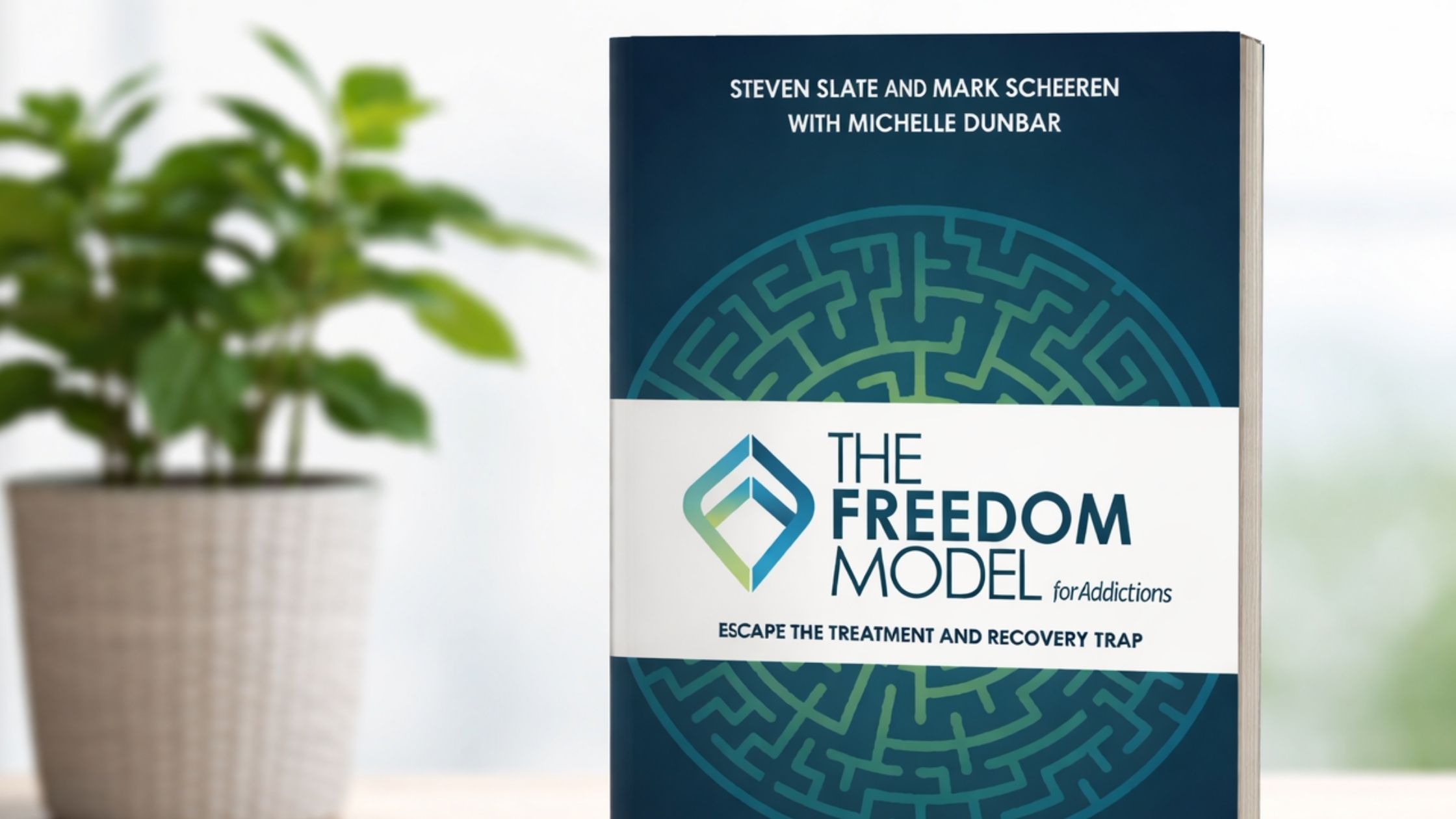
Written by Steven Slate, Mark Scheeren, and Michelle Dunbar, The Freedom Model puts forward a thesis that many will find liberating, others infuriating, and some – if they’re honest – deeply confronting. It argues that addiction is not a disease, or external force, or identity, but rather a pattern of choices shaped by perceived benefits.
In other words: a habit, albeit one with emotional gravity.
Whether or not you ultimately agree with the book’s position, it is undeniably significant. It’s the kind of work that demands you slow down, breathe, and interrogate what you think you know. And in that sense, it’s doing something genuinely useful.
A New Narrative (Whether You Want One or Not)
At the heart of The Freedom Model for Addictions lies a simple but provocative idea: people use substances because they think those substances make life better in the moment.
The authors frame addiction not as an illness or a hijacked brain, but as a preference; a behaviour that has been repeated often enough, and with enough emotional payoff, that it becomes familiar. And humans tend to return to what’s familiar, even when it’s unhelpful. Especially when life is messy.
Instead of locating the problem inside the brain’s wiring or in some inherited defect, the book asks us to consider that perhaps people persist with heavy substance use because they believe, sincerely, that it offers something they value: pleasure, relief, escape, a brief reprieve from discomfort.
Whether this lands as liberating or naïve will depend heavily on your worldview. But it’s hard to deny the appeal of a model that, rather than casting people as broken, sees them as human beings who have been making the best choices they knew how to make.
The Freedom Model’s Direct Challenge to the Recovery Status Quo
If The Freedom Model for Addictions had a subtitle written in plain language, it might be something like:
“Everything you’ve been taught about addiction might be more cultural script than scientific truth.”
The book takes aim at three major pillars of contemporary addiction thinking:
- The disease model
- The 12-step model, with its surrender and powerlessness
- The treatment industry, which the authors argue often keeps people in “recovery” forever
Their point is not subtle: when people are taught they are powerless, they behave as though they are powerless. And when you build an entire identity around being “in recovery”, it becomes very difficult to imagine yourself ever being simply… well, yourself.
You can feel the authors’ frustration throughout the text; frustration with systems they see as outdated, ineffective, and in some cases harmful. You may not agree with every critique, but the honesty is refreshing and does make you consider your own position.
The Positive Drive Principle: Why We Use
One of the book’s core contributions is the Positive Drive Principle (PDP). If you strip away the jargon, the PDP is essentially the idea that human beings are always moving toward what they believe will bring them the greatest sense of happiness or relief, even when that thing comes with consequences.
It is not a moral failing or some ‘broken brain’, but more your mind doing what minds are supposed to do – choosing the perceived best option on the table.
What the authors argue is that people stop or change their substance use when something else genuinely feels like a better life strategy. Not when they’re scared into abstinence. Not when they’re shamed into submission. But when their internal cost–benefit equation shifts.
Some may find this simplistic and, admittedly, I did too when the concept was initially discussed. Having said that, the research and data that they present to support their claims is quite compelling and contributes towards internally questioning if what we’ve been taught is actually as accurate as we would like to think.
Learned Connections: The Stories We Tell Ourselves About Substances
One of the strongest sections of The Freedom Model for Addictions explores learned connections; the meanings, expectations, and emotional associations people develop around their substance of choice.
Clients will often tell me, “Alcohol helps me relax,” “Cocaine switches my brain off,” or “Weed makes everything feel less sharp.” These beliefs are rarely examined with any real curiosity; they simply become assumptions we carry.
The book argues that a lot of these effects are belief-driven, culturally reinforced, or context-dependent. And while I wouldn’t go quite as far as the authors do in minimising pharmacology, the overall point is sound: what we expect from a substance shapes what we experience.
By interrogating these beliefs, the authors suggest, people often discover that the substance isn’t delivering the benefit they once thought it was. And that can be a powerful moment of clarity.
The Addict Identity: The Cage We Build Without Realising
Here’s where the book gets under the skin in that slightly uncomfortable way that good writing sometimes does.
The authors argue that the “addict” or “alcoholic” identity can be one of the most damaging elements of traditional treatment models.
Their view is simple: If you spend years reinforcing an identity rooted in powerlessness, you will behave in ways consistent with that identity.
This isn’t a moral critique; it’s a psychological one. Identity shapes behaviour. If you see yourself as a person with agency, you’re more likely to act with agency. If you see yourself as a lifelong “recovering addict”, you may unintentionally limit what feels possible.
In my own work, I often talk to clients about mindset and belief, and this overlaps perfectly with what the authors present here.
Of course, some people find deep comfort in recovery identities and communities. That experience is valid. But The Freedom Model offers a potent reminder that these identities are not the only way to understand change, and for some individuals, they might be counterproductive.
Mental Autonomy: The Part That Will Divide Readers
If there’s one thing The Freedom Model for Addictions refuses to compromise on, it’s free will.
The authors argue that people always retain the ability to choose, evaluate, reflect, and redirect, even in moments of very heavy use. There are no triggers, no hijacked brains, no irresistible cravings, only moments where one option feels more appealing than another.
This is the part of the book that will spark the most debate, and a part that has not even been resolved for me yet.
For people who have felt crushed under the narrative that addiction is a lifelong illness, this stance can feel revolutionary. For people who have lived through trauma, chaos, and physiological dependence, it may feel reductive, dismissive, or even shaming.
I also have to consider the experience of those neurodiverse people who find challenges with impulse control. I can imagine this might feel like the authors are naive and not taking in their own experience during this section.
The truth, as always, lives somewhere in the nuance, however, nuance isn’t the point of this book. It’s here to make a case, not present all sides.
The How-To Element: Practical Tools Hidden in a Polemic
While The Freedom Model is more polemic than workbook, it does offer a coherent pathway for change:
- Get honest about the perceived benefits of substance use
- Weigh them against the hidden and long-term costs
- Build a vision of a more satisfying life
- Reconstruct your self-image
- Make a decision based on genuine preference, not fear
You won’t find detailed worksheets or structured exercises. What you’ll find instead is an invitation to have a very frank conversation with yourself. And for the right reader, that invitation might be enough.
Where This Sits in the Bigger Addiction Conversation
It’s worth stepping back for a moment. In the broader landscape of addiction science, The Freedom Model for Addictions sits at one edge of the spectrum. It overlaps with well-supported ideas, such as natural recovery, identity formation, and the role of belief, but stands in opposition to much of the neuroscience and biopsychosocial research that informs modern practice.
The book isn’t pretending to be neutral. It is unapologetically ideological. But here’s the interesting part: even ideological frameworks can offer insights worth incorporating.
What the Book Does Well
It restores dignity.
For people who have internalised helplessness, The Freedom Model can feel like someone opening a window in a very crowded room.
It focuses on what people like about substances.
This is far more clinically productive than asking, “Why do you keep doing this to yourself?”
It challenges outdated treatment norms.
Many of the critiques of the rehab industry are painfully accurate.
It offers hope without requiring identity-based recovery.
Some readers will find this profoundly relieving.
And Where It Overreaches
It dismisses neuroscience too casually.
The brain does change with heavy use. That’s not ideology; that’s data. I suspect it is impossible to have a discussion on compulsive behaviours and substance use disorder without incorporating the role of neuroplasticity.
It underestimates trauma and social complexity.
Choice matters, yes. But so do conditions, history, and biology.
Its evidence base is thin.
Internal studies exist, but independent research is lacking.
Its tone can alienate.
Especially for people who genuinely benefit from mutual-aid communities.
This doesn’t invalidate the model. It simply means it isn’t universal. In that matter though, no model is.
Who This Book Is For (And Who Should Approach Cautiously)
Highly suitable for:
- Secular readers
- Individuals who dislike structured recovery culture
- People who feel “stuck” in the disease narrative
- Clinicians who enjoy exploring alternative frameworks
- Anyone who values autonomy and self-reflection
Approach with caution if:
- You have severe physiological dependence
- You need medical or psychiatric stabilisation
- You benefit from community-based recovery
- Trauma is a major component of your story
The model isn’t wrong for these groups, it’s simply incomplete.
Final Thoughts: The Freedom Model as a Conversation Starter
Ultimately, The Freedom Model for Addictions isn’t trying to be a gentle companion. It’s trying to shake the foundations. Whether it succeeds for you will depend entirely on what you need from an addiction narrative.
For some, it will be the first time a book speaks to them without pathologising them. For others, it will feel like a too-simple answer to a very complex reality.
For most, it will be a reminder that there are multiple ways to understand addiction, and that personal agency and the pursuit of a meaningful life matter far more than labels or doctrines.
If nothing else, The Freedom Model for Addictions asks an important question: What if you are far more capable of change than you’ve been led to believe?
Even if you disagree with the premise, it’s a worthwhile question to sit with.
Where to purchase The Freedom Model for Addictions
You can purchase The Freedom Model for Addictions from Amazon in Paperback, Audible, and Kindle.
You can find their website at https://www.thefreedommodel.org/.
Release Hypnosis Melbourne Hypnotherapy
Since 2015, Lawrence Akers has been working under the name Release Hypnosis offering Hypnotherapy and ACT based work to the people of Melbourne or an online service. Based on St Kilda Rd, Release Hypnosis is an easy and convenient location to get to and accessible by the ANZAC station train and tram stop. Release Hypnosis can help with a wide range of presenting issues, and I offer a free 30 minute no obligation discovery call for those who are unsure if hypnotherapy is the right way forward for them.
Book Your FREE 30 Minute Consultation With Release Hypnosis NOW!
Sign up for the FREE Journaling for Addiction Recovery email series!
You may also like to read:
Hypnotherapy: A Guide to Healing Through the Subconscious
The Neuroscience of Gratitude and Effects on the Brain: Unlocking Mental Resilience
What Is The Success Rate of Hypnosis?
Getting Back On Track After a Relapse